





AfDB Approves $184M for Africa’s Largest Solar Plant in Egypt
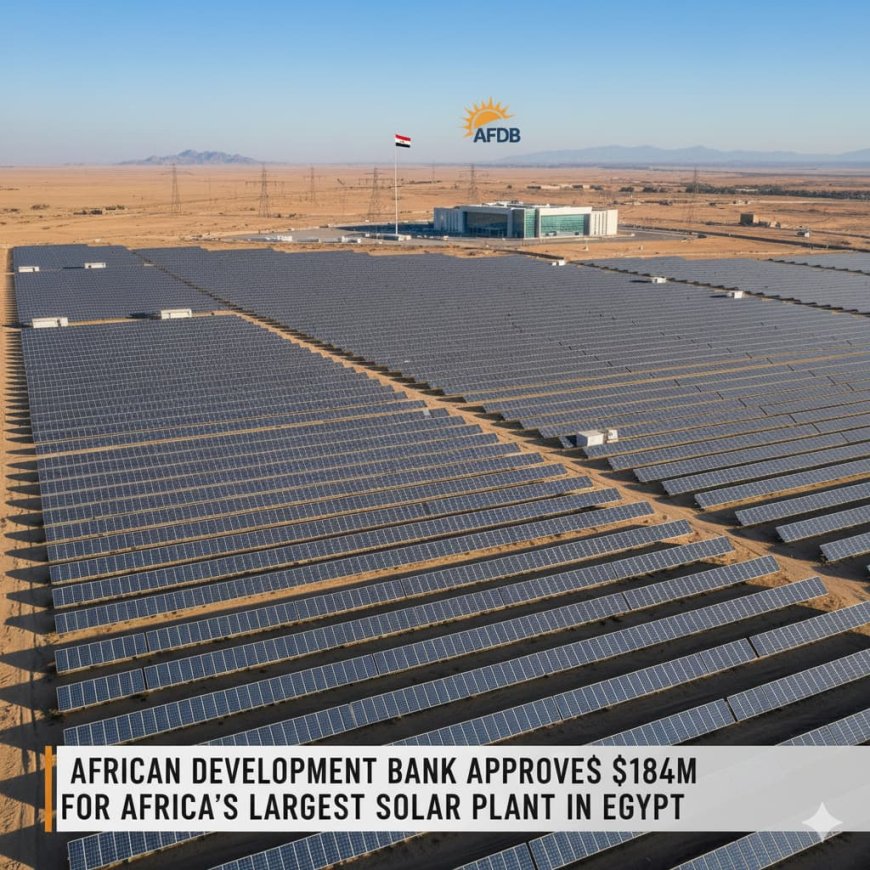
By Thuku Kariuki - In a major stride toward sustainable energy, the African Development Bank Group (AfDB) has approved a $184.1 million financing package to accelerate Egypt’s Obelisk 1-gigawatt (GW) solar photovoltaic project in Qena Governorate.
Set to become Africa’s largest solar power plant, this ambitious initiative will integrate a 200-megawatt-hour (MWh) battery energy storage system (BESS), positioning it as a leading example of large-scale renewable energy integration on the continent.
With a total project cost exceeding $590 million, the Obelisk project is a cornerstone of Egypt’s Nexus of Water, Food, and Energy (NWFE) platform. It promises to deliver clean, affordable power while driving both economic and environmental progress.
Located in sun-drenched southern Egypt, the project involves the design, construction, operation, and maintenance of a state-of-the-art photovoltaic power plant.
The integrated BESS will enhance grid stability by storing solar energy to meet peak evening demand effectively addressing the intermittency challenge of solar power.
The Egyptian Electricity Transmission Company will purchase the plant’s output under a 25-year Power Purchase Agreement (PPA), ensuring long-term revenue certainty and reliability.
Slated for completion by Q3 2026, the plant is expected to generate 2,772 gigawatt-hours (GWh) of clean electricity annually, enough to power hundreds of thousands of homes.
The project is projected to reduce carbon dioxide emissions by around one million tons per year, reinforcing its pivotal role in combating climate change.
The Obelisk initiative is also expected to create 4,000 jobs during construction and 50 permanent positions once operational, prioritizing opportunities for women and youth.
The AfDB’s $184.1 million contribution comprises $125.5 million from its ordinary resources, $20 million from the Sustainable Energy Fund for Africa (SEFA), $18.6 million from the Canada-African Development Bank Climate Fund, and $20 million from the Climate Investment Funds’ Clean Technology Fund.
Additional funding will be mobilized from a consortium of development finance institutions, reflecting strong international support and confidence in the project’s impact.
Dr. Rania Al-Mashat, Egypt’s Minister of Planning, Economic Development, and International Cooperation, hailed Obelisk as a “milestone” for the NWFE program, launched at COP27 in 2022.
The energy pillar of NWFE aims to add 10 GW of renewable capacity by 2030, decommission 5 GW of fossil fuel generation, and attract $10 billion in investments. Since its launch, NWFE has already facilitated 4.2 GW of privately financed renewable projects valued at $4 billion with the AfDB serving as a key partner.
The Obelisk project aligns with Egypt’s national target to generate 42% of its electricity from renewables by 2030, and also supports AfDB’s Ten-Year Strategy and its New Deal on Energy for Africa.
Kevin Kariuki, AfDB Vice President for Power, Energy, Climate, and Green Growth, highlighted Obelisk’s contribution to meeting Egypt’s growing energy needs sustainably.
“This project also contributes to Egypt’s ambition of producing 42 percent of its power generation capacity from renewable energy sources by 2030, while spurring economic growth and reducing greenhouse gas emissions,” he said.
Canada’s Ambassador to Egypt, Ulric Shannon, underscored the project’s importance in supporting Egypt’s transition to a low-carbon economy:
“Canada is proud to support solar energy development in Egypt. This initiative is a meaningful step toward enhancing energy security and stability, with direct benefits for the Egyptian people.”
Wale Shonibare, AfDB Director for Energy Financial Solutions, Policy, and Regulation, described Obelisk as a model for balancing energy security, affordability, and sustainability:
“This project exploits the abundant renewable energy potential in Africa and demonstrates how strong partnerships and innovative solutions can help balance the three core objectives of the energy sector,” he said, noting its potential for replication across the continent.
Awarded a Golden License by the Egyptian government, the Obelisk project has been designated a strategic initiative to alleviate energy constraints and accelerate Egypt’s clean energy transition.
As Egypt taps into its vast solar potential, Obelisk stands as a beacon of innovation, international collaboration, and forward-looking leadership powering a cleaner, more inclusive energy future for Africa and beyond.
What's Your Reaction?