





AI Access Divide Leaves Women Entrepreneurs Behind in Kenya’s Digital Economy
As AI reshapes business in Kenya, women entrepreneurs face a growing digital divide driven by limited access to smartphones, internet and skills.
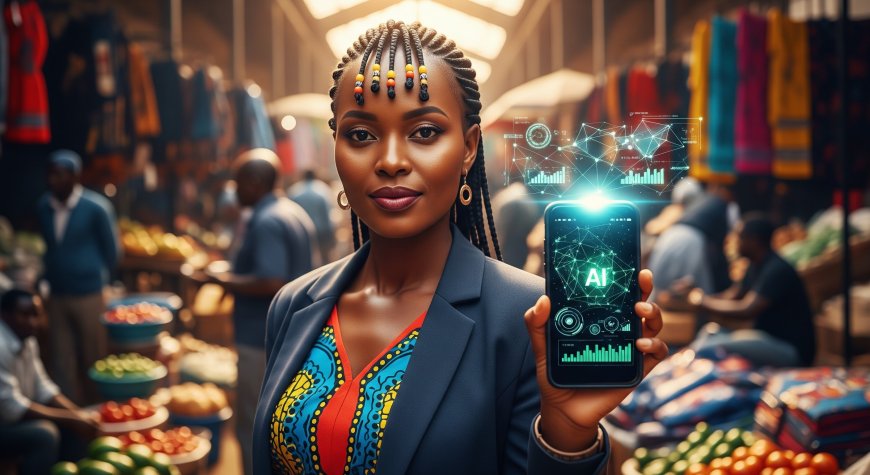
Most of Jael Muchika’s mornings used to begin the same way: staring at her phone and wondering which caption would best promote her small business selling women’s clothes on social media.
Sometimes, she would spend hours thinking about the right words to accompany a photo. Other times, the challenge was figuring out how to design a poster that would stand out among the dozens of posts flooding customers’ timelines.
“It used to be very tiresome. You had to come up with an idea from scratch,” Jael says.
Today, that process looks very different. Small business owners are using artificial intelligence tools for content creation and marketing, though access to smartphones, the internet and digital skills determines who gets to use AI tools.
Jael, who works as a writer, social media manager, virtual assistant, and graphic designer, now relies on AI-enabled tools such as Canva, Gemini, and Lately to generate design ideas, craft captions, and create marketing materials.
“AI gives you ideas on how to design your posts and refine them so they reach your target audience,” she says.
Before AI, captioning was frustrating and time-consuming. Now, the tools help her produce clearer, more effective content aligned with the message she wants to communicate in less time.
“When AI was not there, you had to think through everything. Sometimes you would send a caption, and it would be rejected, either because it was too long or not relevant,” she says. “With AI, my work has become easier. I spend less time and less energy thinking about what to do.”
Still, the results are not always reliable. AI tools can generate captions and designs, but they do not understand local customers, pricing, or cultural tone, meaning users still need to refine outputs and adjust tone.
“Sometimes it gives you captions that don’t match your product or your audience,” she says. “You can’t just copy and paste. If you do, it sounds generic. You still have to edit a lot, and that takes time and data.”
Those who can adapt content effectively gain an advantage over those who cannot, but not everyone can take advantage of AI tools in the same way. Just outside Kakamega town, Mercy Okata’s reality sits on the other side of the digital shift. From her small salon, she styles hair, but her work exists almost entirely offline. Mercy uses a small button phone, commonly known as a katululu or kabambe.
“Clients ask why I don’t market online,” she says. “But how can I post without a smartphone?”
Some of her customers take photos of their hairstyles after appointments and share them on social media, occasionally bringing her new clients. But Mercy herself cannot participate in that space.
She has heard about AI tools from her clients, many of whom are university students from nearby campuses such as Sigalagala and Masinde Muliro. One student told her she had used ChatGPT to design a poster for her food business and was getting orders from it.
“But the first question is always, ‘Do you have a smartphone?’” she says. “That really hit me. I felt left out.”
Moments like that have made the digital world feel distant, something she can observe but not access.
“I even started thinking maybe this is a Gen Z thing, and I’m missing out,” she adds.
She is saving to buy a smartphone, selling vegetables alongside running her salon. But even that decision comes with trade-offs.
“I know I could get one through M-Kopa, but the daily payments add up,” she says. “What if I don’t have Sh80 one day for the phone and still need data? Without that, I’m offline.”
“What if I cannot pay for data one day? My children need school fees. We need food,” she adds.
Even the solutions meant to close the gap don’t always work for her. The Kakamega County government has set up digital hubs where people can access computers and the internet. But for Mercy, leaving her salon to use them is not realistic.
“I can’t step away from my work to go there,” she says. “If I leave, I lose customers.”
She believes support needs to match her reality.
“They should help us get affordable smartphones and teach us how to use them for business,” she says.
The contrast in experiences between Jael and Mercy reveals a gap that is easy to miss in national conversations about AI. For some business owners, AI-enabled digital tools save time and reduce costs. For others, they remain out of reach.
What matters most is not the tool itself, but who can afford to use it consistently. Nearly half of small businesses, about 48.8 per cent, according to a recent local survey, still struggle with digital skills, access to devices or the cost of staying online.
According to Nobert Musundi, a digital trainer in Kakamega, more people are trying these tools, but not all benefit equally. Musundi, who works with Ingovest TechHub, a community-based organisation founded in 2024 to bridge the technology gap among young people in Kakamega, says exposure to digital tools is growing, especially among younger entrepreneurs.
“At the moment, many people are using AI. The question is how they are using it,” says Musundi, who teaches digital skills through the AI for Youth Digital Hub programme.
“Before, someone would pay over Sh1,000 for a poster,” he says. “Now they try to do it themselves.”
Some studies, including research by the World Bank, suggest digital tools can reduce costs and improve efficiency for small businesses. In practice, however, these benefits depend on whether users have the skills and access to use them effectively.
“The shift isn’t automatic. Some people create captions and posters, but they don’t lead to sales, so they still have to learn what works for their customers,” Musundi adds.
That learning curve reflects a broader pattern. Research by the United Nations Conference on Trade and Development (UNCTAD) shows that for many women entrepreneurs, digital skills, not just access, determine whether technology actually translates into income. In its 2025 report on women digital entrepreneurs, the UN body argues that knowing how to use tools effectively is what turns connectivity into opportunity.
Florence Awino, a specialist in women’s digital rights at KICTANet, points to the 11.5 per cent device-sharing gap reported by the Kenya National Bureau of Statistics (KNBS) as one indicator of uneven access.
“You cannot build AI literacy in stolen moments. AI tools require experimentation and learning through iteration. When a woman must wait to borrow a smartphone, she is not just losing screen time; she is losing the privacy to track her business expenses or access credit without surveillance,” she explains.
Awino adds that taxes on airtime increase the burden.
“Connectivity for economic participation must be treated as a public good,” she says. “Without affordable access, these tools remain out of reach for many.”
Awino also raises concerns about how these systems are built. Many are trained on data that does not reflect informal, community-based businesses or local contexts.
“If women are not involved in how these systems are designed, existing inequalities can be reproduced,” she says.
Safety is also a concern. Cecilia Maundu, a journalist and digital safety advocate, says many women face harassment online, affecting both their personal safety and visibility.
“She is selling clothes, but she is also sharing her personal life. When attacks come, they affect everything,” she explains. “Many women leave platforms because of harassment.”
At the policy level, gaps remain. Kakamega County’s ICT director, Chrisantus Odongo, says efforts to expand digital access are ongoing, but not specifically targeted at women.
“We have not focused on women’s groups. Our selection is usually random,” he says of the digital skills training that the county offers. This limits support for those facing the greatest barriers and reinforces existing inequalities.
The stories of Jael and Mercy reflect different experiences within the same system. The difference is not individual effort, but the conditions that shape access, use, and safety.
As AI-enabled tools become more embedded in everyday business, the divide is no longer just about access to technology; it is about who gets to grow, compete, and stay visible in the market. Without addressing cost, access, skills, and safety, these tools are likely to benefit some groups more than others.
This article was produced as part of the Gender+AI Reporting Fellowship, with support from the Africa Women’s Journalism Project (AWJP) in partnership with DW Akademie. The journalist used AI tools as research aids to review and summarise relevant policy and research documents and extract key statistics. All analysis, editorial decisions and final wording were done by the reporter, in line with Story Spotlight’s editorial standards.
What's Your Reaction?