




Ambassador Calls for Inclusive Leadership and Girls’ Voice in Decision-Making
Dutch Ambassador Henk Jan Bakker calls for inclusive leadership and greater participation of girls in Kenya’s decision-making spaces.
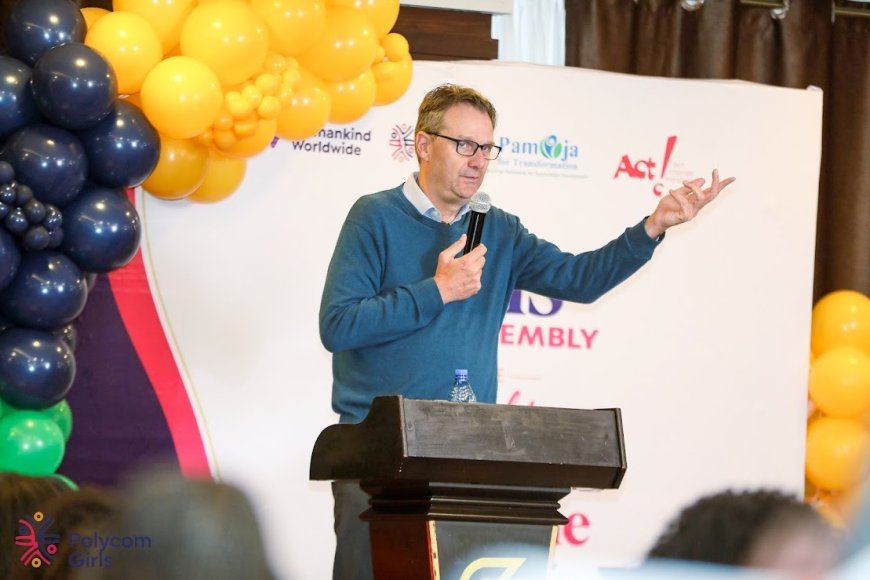
By John Mwilwatsi - The call for more inclusive leadership took centre stage at the 6th Annual Girls Assembly, where Dutch Ambassador to Kenya Henk Jan Bakker urged leaders to listen to diverse perspectives and create space for girls to participate in decision-making.
Speaking during the assembly convened by Polycom Girls under the theme “Unleashing Authentic Feminine Leadership,” Bakker said leadership should not be about surrounding oneself with people who simply agree, but about listening to different perspectives and creating opportunities for meaningful participation.
Bakker’s call highlights a persistent structural deficit in Kenya's public governance. According to official electoral data from the Inter-Parliamentary Union (IPU) and the Independent Electoral and Boundaries Commission (IEBC), women currently hold just 23.3 percent of seats in the National Assembly (82 out of 349) and 31.3 percent in the Senate (21 out of 67).
Notably, in directly elected single-member constituency races, women won only 29 out of 290 seats. leaving Parliament out of compliance with Article 27(8) of the Constitution of Kenya regarding the Two-Thirds Gender Rule.
He also emphasised the importance of communities and governments in advancing sustainable development, noting that while development partners can provide support, lasting development and scale ultimately require local ownership.
The assembly brought together women leaders, policymakers, development partners and women's rights advocates for dialogue, learning, networking and the exchange of ideas on leadership, governance and the participation of girls and women in decision-making.
Polycom Girls Founder and Executive Director Jane Anyango said the organisation remains committed to equipping girls with leadership skills and encouraging their meaningful participation in governance and political processes.
Aphline Yogo, Programs Officer at Polycom Girls, said creating opportunities for girls to articulate and advance their own ideas remains central to the assembly.
“Girls are pitching their ideas and we want them to be realized,” she said.
Yogo explained that the assembly is centred on intentional participation and ownership, with girls contributing to shaping both the event and the conversations taking place.
She said the approach seeks to ensure that girls are not merely participants in discussions but also have opportunities to develop and advance ideas on issues affecting their lives.
For Florence Syevuo, Executive Director of the SDGs Kenya Forum, development conversations must reflect the realities experienced by girls and young women.
“SDGs embody the lived realities of the girls,” she said.
Syevuo pointed to issues including safe environments, menstrual health and hygiene, and technology-facilitated gender-based violence as examples of challenges that form part of girls' everyday experiences.
Syevuo’s emphasis on menstrual hygiene directly addresses a major driver of educational disruption. Joint assessments by the Ministry of Health and UNICEF Kenya reveal that approximately 65 percent of women and girls in low-income and rural areas cannot consistently afford basic sanitary products.
Consequently, primary school girls lose an average of 3 to 5 instructional days per month, amounting to nearly 20 percent of a school year lost due to period poverty.
Furthermore, as civic participation shifts to digital spaces, young women face escalating risks online. While the Kenya Demographic and Health Survey (KDHS) records that 34 percent of women in Kenya experience physical violence, research by Amnesty International Kenya and Policy indicates that over 70 percent of female public figures, young activists, and civic participants report experiencing online abuse, cyberbullying, or non-consensual image sharing, acting as an invisible wall that censors girls out of digital public discourse.
“We cannot do development from a place of what we know. We must include the girls as we seek answers,” she reiterated.
Through its assemblies and related initiatives, Polycom Girls says it has connected more than 1,000 young women with mentors, policymakers, women leaders, donors and development partners.
The organisation says these connections have helped translate commitments into opportunities for girls to lead and influence change in their communities.
What's Your Reaction?