








Bungoma Youth Lead Climate Fight Amid Floods, Droughts and Land Challenges
Bungoma youth are leading climate action against floods, droughts, and land challenges, turning adversity into sustainable solutions and hope.
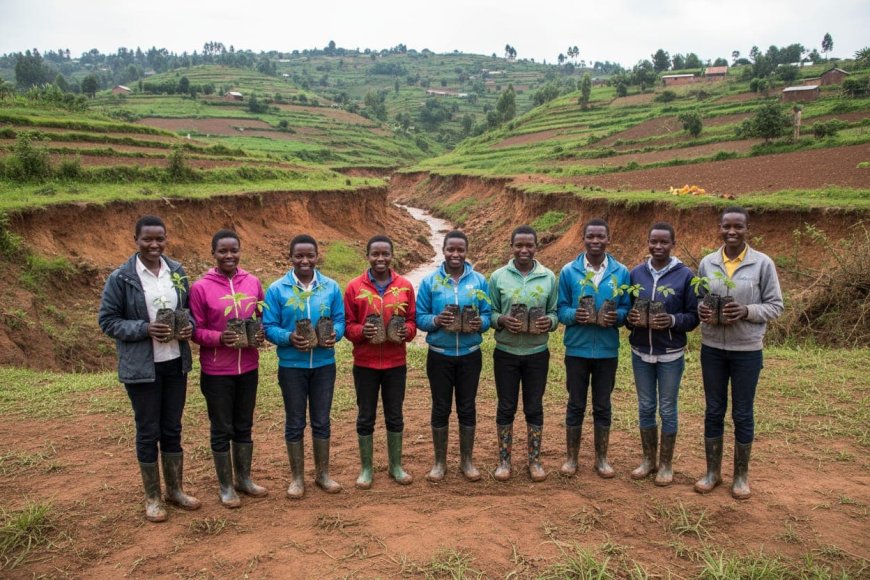
On the slopes of Mount Elgon, youth gather along flooded streams, planting seedlings to stop soil erosion. Last year, rivers washed away homes and maize fields, but young people like Namusasi Erick Makokha are refusing to wait for help. They are taking action to fight the climate crisis reshaping Bungoma County.
Timothy Tumwet, a teacher from Cheptais, has watched the land around him change in ways that still unsettle him.
“I’ve seen rivers dry up and others overflow,” he says. “Trees are disappearing, and with them, the water. But people are now planting trees on their own, and that gives me hope.”
That hope is spreading across Bungoma.
Young people are refusing to give in to floods, droughts, and the uncertainty that touches every home. For them, climate justice is not a distant concept. It is the fight to protect their families, their land and their future.
For decades, Bungoma’s fertile soils were the pride of the region. Today, the same land tells a harsher story. Seasons shift unpredictably, farmers struggle to know when to plant, and floods can erase months of work in a single afternoon.
These local changes mirror a global crisis. According to the World Meteorological Organization WMO's 2025 climate update presented at COP30, global temperatures are already 1.42 °C above pre-industrial levels, making extreme weather events more frequent and unpredictable.
“I grew up thinking farming would feed my family forever,” says Namusasi Erick Makokha from Webuye East. “But the soil doesn’t produce like before. I want to plant trees, but I have no land. You can’t just go to someone’s farm and plant without permission.”
Makokha’s frustration reflects the struggles of thousands of young people across the county, eager to act but held back by lack of land, limited finances, and little say in decision-making.
Their struggle is not only personal. Across Africa, climate extremes cost 2–5% of GDP annually, with some countries losing up to 15% of per capita income, showing how climate disruption directly affects livelihoods and opportunities for youth.
A recent study by the Youth Initiative for Land in Africa (YILAA) revealed a deeper problem: only 27.6 percent of youth in Bungoma can clearly define climate justice, even though droughts, deforestation, and floods regularly disrupt their communities.
“Youth have energy, passion, and ideas,” says YILAA Executive Director Innocent Antoine Houedji. “But they are rarely included in decisions that affect their lives. You can’t talk about climate without talking about land. Without land security, young people cannot act.”
For many, climate justice is not abstract. It determines who eats, who rebuilds, and who is left behind after each disaster.
“It’s natural and cultural that women don’t inherit land,” says Joyce Chepchumba from Mount Elgon. “But things are changing slowly. Some of us now grow kitchen gardens and use biogas instead of firewood. Small steps, but they make a difference.”
Her words highlight a deeper tension: gendered land traditions, long unchallenged, now limit young people’s ability to adapt to a rapidly changing climate.
Kenya’s National Climate Change Action Plan (NCCAP) promises community-driven solutions. But youth in Bungoma say those promises rarely reach them.
“Only 27 percent of youth even know the county has a climate policy,” says Deborah Oyugi, YILAA’s Anglophone Countries Manager. “Young people are invited to meetings, but their views don’t shape decisions. It’s tokenism, not participation.”
Many youth-led initiatives flare up around ceremonial days such as Mazingira Day, only to fade once the event ends. County structures to nurture sustained action are few.
Part of the challenge is financial. Africa needs US$52–88 billion per year for climate adaptation, yet receives less than US$11 billion, leaving communities and youth initiatives severely underfunded.
Yet some young people refuse to wait. In Bungoma town, Nanjekho Mulati leads the Youth for Sustainable Development (YSD), organizing school visits, clean-ups, and awareness campaigns.
“What motivates me is that women and girls bear the heaviest burden of climate change,” she says. “We fetch water from farther away, cook with firewood, and care for families during floods. I want to lift that burden.”
Through YILAA’s eco-preneurship program, Mulati and her team are turning plastic waste into jewellery, handbags, and home décor, transforming pollution into income.
“It’s not just about planting trees,” she says. “It’s about growing livelihoods.”
Across Bungoma, similar innovations are taking root. Youth groups are starting tree nurseries, organic gardens, and beekeeping projects.
“I started with two beehives,” says Brian Wekesa from Kimilili. “Now I have ten. The bees give me honey to sell, and they pollinate crops. It’s climate action that pays.”
Slowly, these efforts are building local green economies, small, but full of promise.
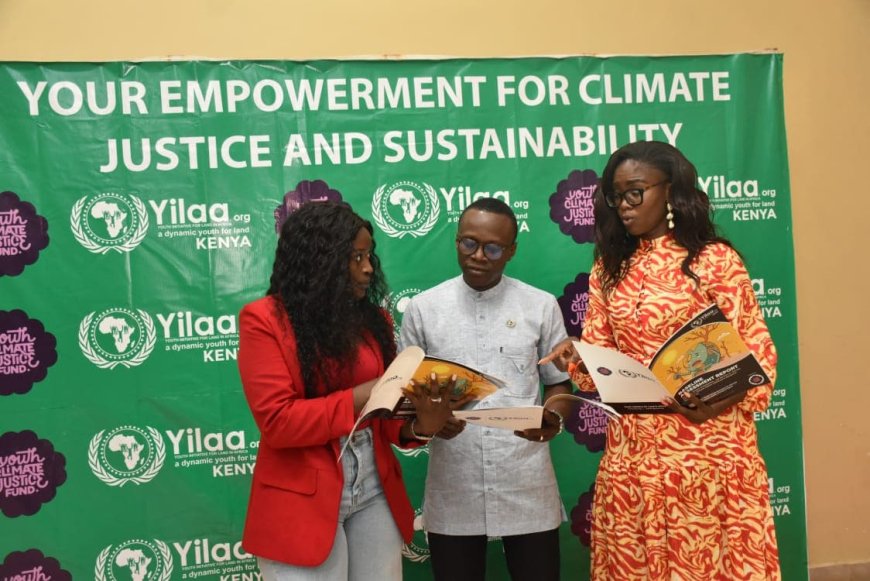
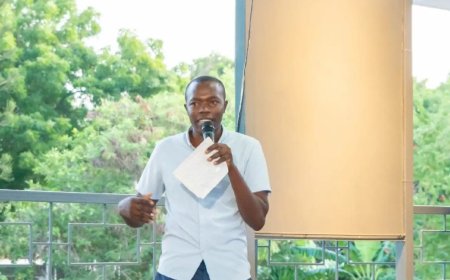
From left - YILAA programme director (kenya) - Julie tsuma, Youth Initiative for Land in Africa - Yilaa Executive Director, Innocent Antoine Houedji (from Benin)-centre and Deborah Oyugi – Volunteer Anglophone Countries Managerat bungoma siritamu hotel during the launch of the program
Still, land access remains the biggest barrier.
“When you don’t have the right to access land, you can’t do much,” Oyugi says. “Climate justice means inclusive land ownership. Without that, poverty and environmental degradation continue.”
The YILAA study recommends gender-sensitive land reforms, county-level climate funds, and the creation of a Bungoma Youth Climate Action Network to link youth groups with government and civil society.
According to a Global Center on Adaptation and Climate Policy Initiative analysis, Africa’s adaptation finance needs could grow 5‑ to 10‑fold by 2035, underscoring the urgency for youth-led networks and more accessible funding.
“If you give young people even a small piece of land, they’ll do wonders,” says Tumwet. “They’ll plant trees, grow vegetables, protect the soil, because their future depends on it.”
Signs of change, though modest, are appearing. Women’s groups adopt biogas and energy-saving stoves. Schools form environmental clubs. Churches teach conservation. Communities are slowly learning the language of climate awareness.
“Before, people didn’t take climate seriously,” says Chepchumba. “Now, when floods or droughts come, we understand what’s happening. We talk about it everywhere, schools, markets, churches.”
Even online, the movement grows. Through hashtags like #GreenBungoma and #YouthForClimateAction, youth share clean-ups, innovations, and success stories.
Last year, flash floods destroyed Makokha’s maize field.
“I cried that day,” he remembers. “But afterward, I joined a tree-planting group. Even if I don’t own land, I help plant in schools and along rivers. It gives me peace.”
Today, he is a trained climate champion, mentoring youth across his village. Each trainee guides 15 more, spreading knowledge like seeds in the wind.
Experts insist the county must move from talk to action.
“We’ve seen good policies gather dust,” Oyugi warns. “What’s needed is implementation and inclusion. Youth must have a seat at the table, not a token chair at the back.”
The YILAA report calls for climate funds, school-based climate education, and grants for youth innovation.
“These ideas come from the youth themselves,” Houedji says. “Africa’s climate justice future depends on empowering them now.”
In Webuye East, the Tuungane Green Hub youth collective has raised over 12,000 seedlings in just three months, supplying schools, churches, and farmers.
“We started with nothing but an idea,” says Sharon Nekesa. “Now even elders come to ask for seedlings. It shows they believe in us.”
Across the county, these initiatives multiply, proving that Bungoma’s youth are not waiting for help.
“If we wait for others, we’ll wait forever,” Nekesa says. “We live with the floods and droughts. We must act.” Bungoma’s young people are fighting two storms, one in the sky and one in society, yet they push on.
“Bungoma is blessed with human capital,” says Oyugi. “We can be the generation that gets it right on climate justice, but only if we equip youth to do so.”
As the sun sets behind Mount Elgon, its light touching farms, rivers, and homes still recovering from the last storm, one truth remains: No one is coming to save them.
What's Your Reaction?