








Four-Tonne Fish Harvest Signals Climate-Smart Farming Success in Busia Irrigation Project
Farmers in Busia County harvest four tonnes of fish from the Namalenge Irrigation Project, showcasing how climate-smart agriculture and irrigation are improving livelihoods and strengthening resilience to erratic weather.
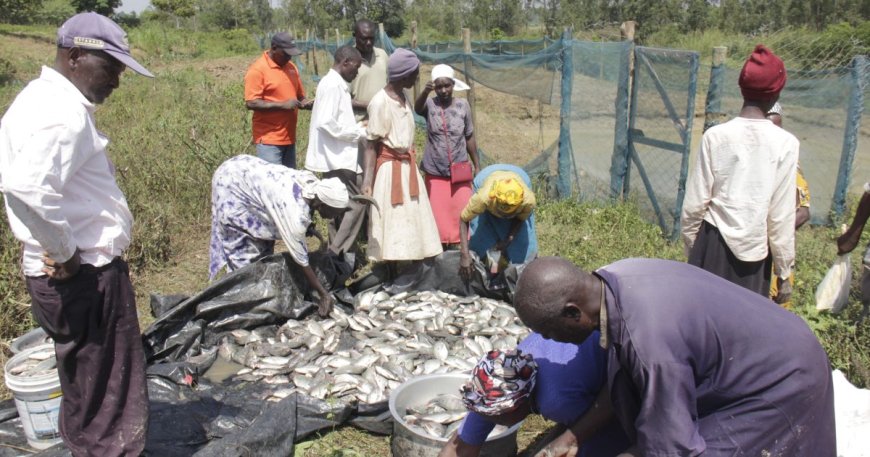
At dawn in Namalenge, Phylis Makokha walks quietly along the edge of a fish pond, her reflection stretching across the still water as the first rays of sunlight break over the horizon. For months, she has fed the fish, monitored water levels and hoped that unpredictable weather would not undo their efforts.
Makokha is among the beneficiaries of the Namalenge Irrigation Project in Matayos Sub-county, Busia County, where farmers have just harvested four tonnes of fish (4,000 kilograms) from ponds that once symbolised uncertainty more than promise. For Makokha and dozens of other households involved in the project, those figures are not abstract calculations. They mean school fees paid on time, food on the table, and the ability to plan for tomorrow with confidence.
“This project has allowed us to sustain ourselves,” she says, watching as the fish are sorted into crates for the market. “Besides fish farming, we grow vegetables throughout the year because we have reliable water. From the fish harvest, we can pay school fees and take care of our daily needs.”
For years, climate variability in western Kenya disrupted planting seasons and exposed farmers to frequent crop losses. In Namalenge, however, structured irrigation has helped stabilize production. With a controlled water supply, farmers can maintain regular fish feeding schedules, grow vegetables throughout the year, and plan harvests according to market demand rather than the unpredictability of rainfall.
Project chairman Melitus Odongo described the harvest as a turning point for the scheme. At a projected market price of between Sh350 and Sh400 per kilogram, the harvest is expected to generate between Sh1.4 million and Sh1.6 million in gross returns.
“This is not an individual venture. It is a community initiative that is benefiting many families. What we have achieved shows that with more government support, especially in the supply of fingerlings, fish feeds, and the construction of additional ponds, we can expand production and uplift even more households,” Odongo said.
The irrigation scheme, funded at a cost of Sh15 million under the Financing Locally Led Climate Action programme supported by the World Bank, currently operates on 80 acres, though it has the capacity to expand to 100 acres. Even at its present scale, its impact is visible across the community.
By integrating aquaculture, horticulture and livestock farming, the project has created multiple income streams for farmers, reducing reliance on rain-fed agriculture in a region long affected by erratic weather patterns.
The benefits extend beyond the ponds. Youth in the area are now engaged in pond maintenance, feeding programmes, harvesting, and marketing, gaining practical skills and a steady income. Some are already preparing to establish their own fish ponds, inspired by the success of the communal scheme.
Women, too, are increasingly taking leadership roles in agribusiness, viewing aquaculture not merely as a supplement to household income but as a pathway to financial independence.
The economic ripple effect is also significant. If the 4,000 kilograms of fish sell at an average price of Sh375 per kilogram, approximately Sh1.5 million will circulate within the local economy. Traders, transporters, and market vendors all stand to benefit, while consumers gain access to fresh, locally produced protein at competitive prices.
According to Busia County Director of Irrigation Dismus Otula, the Namalenge Irrigation Project stands out as a unique integrated agricultural model in the county.
“Although the project has the capacity to cover 100 acres, it is presently operational on 80 acres. Even at this scale, its impact is visible. Farmers grow vegetables alongside the fish ponds, using the reliable water supply to maintain consistent crop production throughout the year. Livestock rearing complements the system, ensuring diversified income streams,” Otula said.
Otula added that county authorities are working toward transforming Namalenge into a technology transfer centre where farmers from across the region can receive training in modern irrigation methods and climate-smart agriculture.
“The goal is to boost productivity while preparing communities to withstand the growing challenges of climate change,” he said.
Busia County Director for Climate Change Dan Opilio said the initiative was designed to strengthen local resilience by empowering communities to lead development projects tailored to their needs.
“What we are witnessing with this fish harvest is evidence that the project is fulfilling its objective. By ensuring a reliable water source and promoting diversified farming, we are reducing vulnerability to erratic rainfall and climate shocks,” Opilio said.
Despite the milestone, farmers say challenges remain. The high cost of quality fish feeds and occasional shortages of fingerlings threaten to slow expansion. Infrastructure improvements, including additional ponds and storage facilities, are necessary to sustain growth.
Odongo appealed to both levels of government to view Namalenge as a scalable model worth investing in further.
“If more resources are allocated, we can increase production significantly. Fish farming is one of the most practical ways for communities near wetlands to improve their livelihoods. We encourage residents to form groups so that they can access government assistance and replicate this success,” he said.
As the harvest concluded, the sense of accomplishment among the farmers was unmistakable. What was once an ambitious project on paper has become a living example of how targeted climate funding, community participation, and government partnership can transform livelihoods.
The Namalenge Irrigation Project illustrates the power of integrating irrigation, aquaculture and community-led initiatives in building climate-resilient farming systems for the future.
What's Your Reaction?