





Clean Energy Powers Kenya’s Food4Education Sustainable School Meal Program
By Melisa Mong'ina
In a country grappling with the effects of climate change and environmental challenges, clean energy plays a crucial role in reducing emissions and pollution. At Food4Education’s Giga Kitchen, located in Nairobi's Industrial Area, this commitment to sustainability is evident.
The facility, which prepares nutritious meals for approximately 60,000 school children daily, prioritizes environmental protection while ensuring a safe working environment for its own kitchen staff and the people around the industry.
The meals are often prepared by use of steam which conserves the environment by eliminating smoke and excess heat. This method not only speeds up the cooking process but also reduces energy costs.
Marking International Clean Energy Day, a visit to the Giga Kitchen provided a firsthand glimpse into the transformative impact of clean energy on the environment, showcasing its potential to drive sustainable change.
During the visit, Shalom Ndiku, Head of Policy and Partnerships, shared a brief history of the kitchen and how Food4Education integrated clean energy into their kitchen.
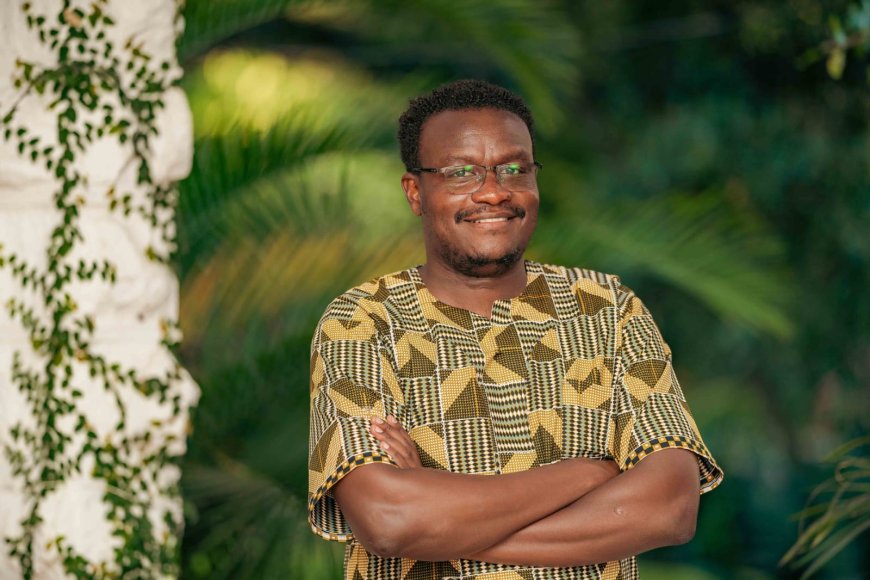
Shalom Ndiku, Head of Policy and Partnerships at Food4Education
He narrated that Food4Education was founded in 2012 by Wawera Njiru. Initially, it started as a small-scale operation that fed 25 learners, from Njiru’s home kitchen in Ruiru.
“Food for Education was founded in 2012 by Wawera Njiru and it started with her feeding 25 learners, cooking from her house or home kitchen,” said Ndiku.
With time, the kitchen expanded and they started using firewood as their primary source of energy since it was the easiest form of energy during that period. The use of firewood made them use a lot of energy, polluting the environment with carbon emissions.
“Our first kitchen was in Ruiru, and just like any other kitchen, we started by using firewood for cooking since it was the easiest form of energy. We later realized that with firewood a lot of energy was consumed and it also polluted the environment by emitting Carbon dioxide into the atmosphere. Using firewood was also seen as a destruction of trees,” he added.
Due to the environmental impact of firewood, they decided to transition to the use of IKO-briquettes which were made from other forms of waste that last longer and emit less carbon into the environment. It also reduced deforestation since no more trees were cut to provide firewood.
“As we were scaling, we realized that we were spending thousands of tons just on energy. So we transitioned to using IKO-briquettes that are made from other forms of waste that not only last longer but also emit less carbon dioxide, preventing the removal of trees from the environment,” he said.
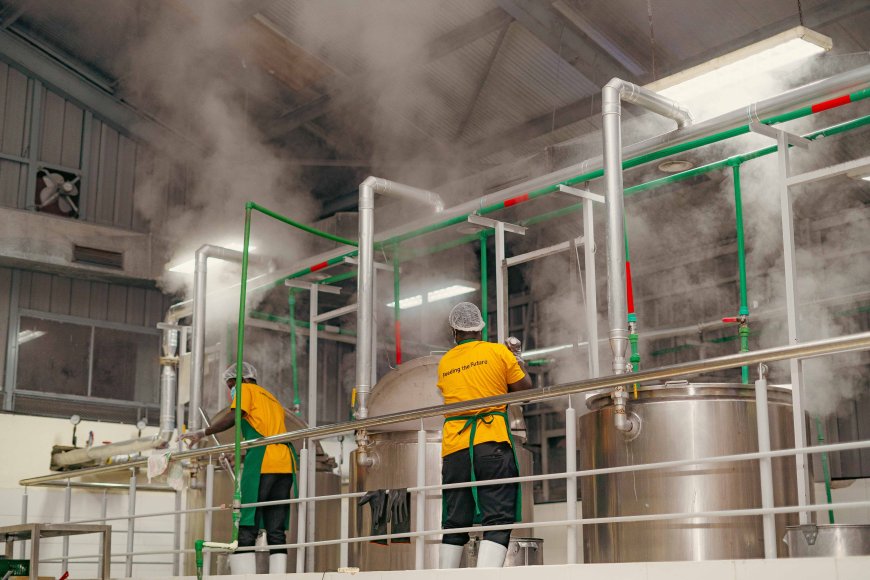
Kitchen staffs preparing meals for the learners using the generated steam
The use of IKO-briquettes led to significant growth of the organization. They were able to modernize the old Ruiru kitchen which used to feed 25 learners and now the growth has enabled them to provide meals to 450,000 children daily.
“If you go to Ruiru kitchen, you'll see the old kitchen that has the older technology, but still uses IKO-briquettes, but a more modern one with steam cooking. That has been the big integration we've done, as we have scaled now to feed 450,000 learners every day, as compared to those 25 learners before,” stated Ndiku.
This shift from firewood to IKO-briquettes and steam cooking was not with ease. One of the challenges was maintaining affordable meal costs while ensuring the sustainability of energy use. The transition was made possible with the support of IKO Briqs, the supplier of the briquettes.
“The transition was not easy, particularly from an economic point of view. We had to make sure that the cost per meal to the child was affordable. We also had to be innovative and look at various suppliers. As of now, the supplier that we work with, called IKO Briqs, was able to provide us with that solution,” Ndiku shared.
As the organization scaled up, the shift to these more sustainable energy sources became easier, though firewood is still commonly used in many schools.
“We noticed that many schools in the country still used firewood and for us to be in this position, scaling up has helped. As we have grown, we've seen the advantage of shifting, and we have done it, at least with some ease as compared to earlier,” said Ndiku.
Energy Consumption, Environmental Impact, and the Use of Technology in the School Feeding Program
According to Ndiku, the use of steam energy has been utilized in many of their kitchens, such as in the Giga kitchen, where they use the IKO-briquettes to generate heat, creating steam that powers the cooking process. This method is more sustainable, and efficient.
“In a number of our kitchens, including this one here, Giga, we utilize steam energy. The IKO-briquettes are burnt in the boilers creating heat, which then generates steam using the technology you’ve seen and then it powers the cooking process,” explained Ndiku.
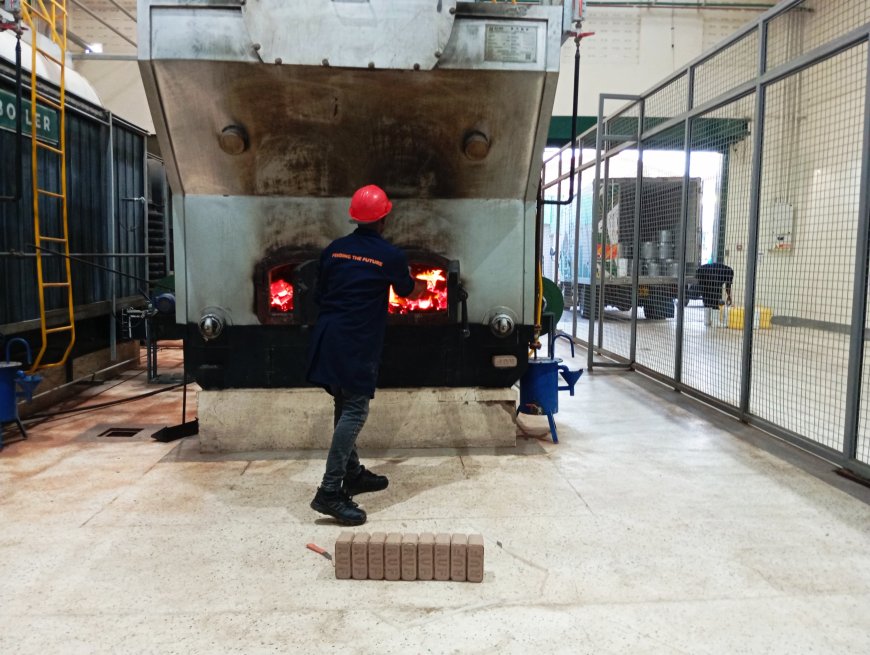
Boiler operator putting the Briquettes in the boiler
Initially, Food4Education was using a huge amount of firewood to prepare the meals, but after shifting to IKO-briquettes, the energy consumption has 16,000 tons of IKO-briquettes daily across their 29 kitchens compared to firewood which would have required much larger quantities to provide the same energy.
“Right now we're using about 16,000 tons of IKO Briqs a day, in our 29 central kitchens. At first, we were consuming more firewood and when you compare, you'll find out that firewood will be consumed more for less energy while IKO Briqs are consumed less for more energy,” he said.
He further highlighted that the environmental impact of using the briquettes is substantial because the use of firewood every day would lead to deforestation caused by cutting down trees for firewood.
“The average weight of a decent-sized tree is about half a ton, maybe 500 kilos. So, you're looking at 32,000 trees. If you double that every day, it would be a massive backward step as compared to what the government is trying to push with the climate agenda, with growing trees,” stated Ndiku.
This approach has also helped reduce air pollution around schools, making the environment healthier for both students and nearby communities.
“We're also making sure that our communities are not in polluted environments since the majority of our kitchens are in schools. We aim to protect nearby learners from smoke pollution,” he stated.
Regarding waste management, Food4Education takes a sustainable approach by recycling 100% of its waste. This commitment to recycling and reusing waste ensures that the program operates in an environmentally responsible manner.
“Our waste is 100% recycled. It is distributed for other purposes. It could be taken to farms for consumption or used by farmers. I think even the ash that we use is also reused as well. We have 100% reuse of the waste that comes from here,” he explained.
Ndiku shared that one of the tools that has significantly helped their operations is TaptoEat, a technology that allows them to track and monitor children's eating habits.
This technology provides valuable data, such as meal frequencies and the health patterns of leaners, which helps the organization make informed decisions about how to support the children better.
“We use TaptoEat, a technology that has helped us a lot. This technology gives us data that we can use to understand the nature of these children, such as meal frequencies and children's eating habits. If a child skips a particular meal, TaptoEat informs us and from there, we can contact the parent and know where the problem lies,” he said.
Initially, the organization faced challenges when parents didn't have enough money to pay for meals. However, TaptoEat now provides a solution by allowing parents to top up funds digitally, making the payment process smoother and more efficient, ensuring that children consistently receive their meals.
“When we started in 2012, we used to ask money from parents and then you could find a child has come with KSh 100 and he probably pays KSh 20, and finding the change was difficult. With the new technology, TaptoEat the parent can now top up digitally and the child will eat without any problems,” Ndiku explained.
The Process of Generating Steam for Cooking and Energy Conservation at Giga's Kitchen
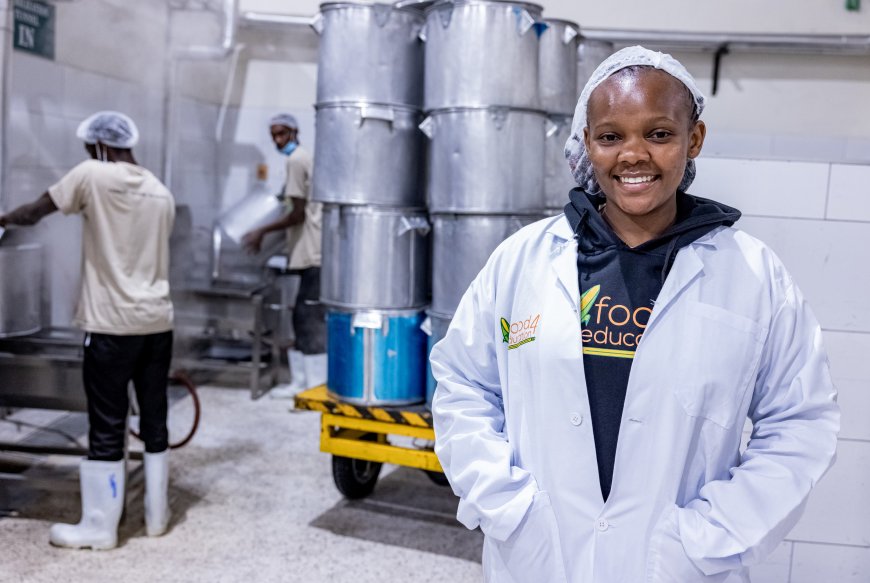
Catherine Kinuthia, Giga's Kitchen Manager
Catherine Kinuthia, Kitchen Manager at Giga's kitchen Food4Education, narrated how they generate steam using locally sourced briquettes for their cooking process. These briquettes are first placed into a chamber that functions similarly to an oven, where they are lit and allowed time to prime, then after that it builds up the pressure in the boiler, which later produces steam.
“As I had mentioned, the briquettes are also sourced locally, so they go into the chamber you saw earlier which looks like an oven. Once it's lit up, we give it time, it's called priming time. This builds up the pressure in the boiler, which is essential for producing steam to the whole system,” she shared.
Thereafter, the water is automatically introduced into the boiler where it then heats up to reach the ideal temperature, which later transforms into steam. With the help of the boiler operator, the steam is then distributed throughout the cooking system, allowing the food preparation process to begin smoothly.
“After priming, the water gets automatically into the boiler and it's then heated up. Once it gets to the ideal temperature, it transforms into steam. From there, our boiler operator distributes the steam across all the vessels, allowing food preparation to take place. He will then be monitoring the pressure and temperature to ensure the process moves smoothly,” she narrated.
Catherine shared the advantage of using the steam over water, as it helps conserve water by recycling. After the steam cools down and condenses, the hot water is then reused for cooking, washing, and cleaning, reducing water wastage. This process also helps in conserving electricity since they only use it for lighting in the kitchen.
“Once the steam cools down it condenses back into hot water. Instead of boiling water for cooking and sterilization using electricity, we use the condensed hot water from the steam, reducing water waste. We only use electricity to run the fans for the boilers and lighting in the kitchen, but everything else is powered using the briquettes,” she added.
She emphasized the environmental benefits of using briquettes. Unlike traditional fuels, the briquettes are smoke-free, and they are made from compressed organic refuse and other waste materials, preventing the need for cutting down trees.
“One of the benefits is that they are smoke-free. If we were to go outside, we really wouldn't know that anything is burning in this kitchen. Secondly, they are made out of compressed sawdust and other forms of organic refuse, eliminating the cutting down of trees for firewood or using trees to make the briquettes,” said Catherine.
The use of briquettes is also cost-efficient compared to electricity, reducing operational costs. Additionally, the system is highly efficient, as it doesn't require a lot of tonnes to produce the needed stream, making it a highly effective and environmentally friendly method of cooking.
“Thirdly, the use of briquettes is quite cost-efficient compared to electricity, reducing operation costs. We don't have to use so many briquettes to produce steam because using just 2.5 tonnes can be able to produce 60,000 liters of steam, making it quite efficient,” she added.
Improvement in the Workers' Environment at Giga Kitchen and its Impact on Children
Catherine compared the current working conditions with those of the past, highlighting improvements in comfort. She believed that the use of briquettes has improved this situation, offering a cleaner and more comfortable working space.
“The use of briquettes has been quite an efficient mode of cooking in this initiative, compared to where we were 12 years ago. I believe that there has been an improvement in comfort for our workers since there's no smoke or heating around this kitchen,” she stated.
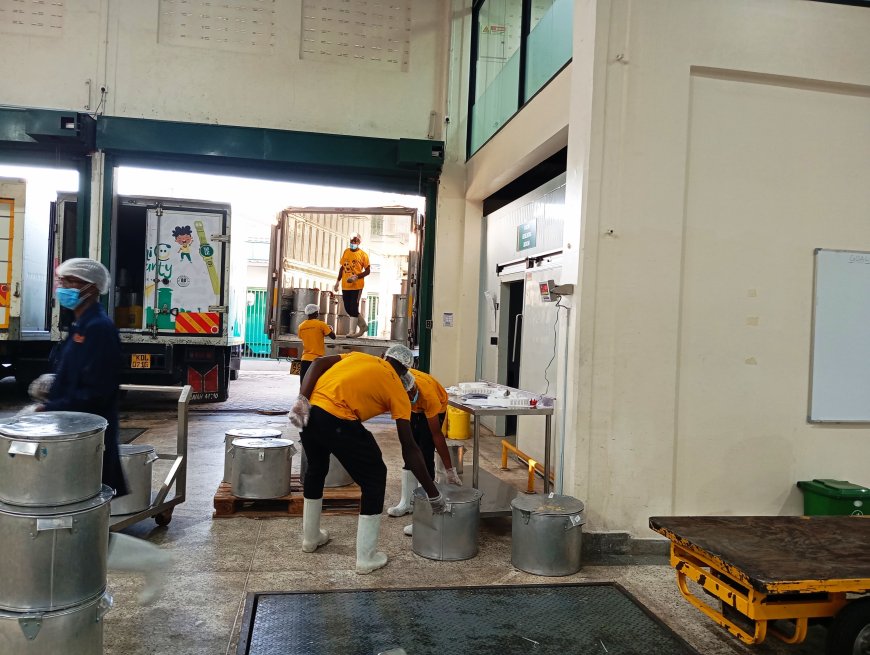
The distribution of meals from Giga Kitchen to schools in Machakos, Kajiado, and Nairobi
She further highlighted that the workers receive training before starting their roles. The training lasts for about two weeks to a month. It not only includes cooking skills but also how to operate the equipment and monitor the necessary parameters, such as temperature and pressure, to avoid accidents.
“Before any kitchen launches, we often have around two weeks to one month of training, to equip the workers with better cooking skills. They are also trained on how to operate the machines and monitor the necessary parameters, such as temperature and pressure to minimize accidents in the kitchen,” she explained.
She believed that the clean energy initiative has a positive impact on the children who depend on these meals. By prioritizing environmental conservation, Food4Education contributes to a better future for the next generation.
“I believe that this clean energy initiative has a positive impact on these children, because we want to feed the future, and create a better future so prioritizing environmental conservation makes it better for them and the next generation,” said Catherine.
Partnerships, Collaboration with Local Communities, and Plans for Future Expansion
Ndiku highlighted that their organization works with a wide range of partners, including suppliers such as those who provide briquettes and trucks, ensuring that the children receive their meals on time.
Local farmers are also part of the partnership since they supply the organization with vegetables and cereals that meet the nutritional value needed. Government agencies such as the Ministry of Education, Agriculture, and Health also play a crucial role in the program.
“We work with some of our suppliers, such as those who provide us with the briquettes and trucks to ensure the children get the meals that they require. The vegetables that we get are from farmers in 13 counties. We work with actors in the food security space, Ministry of Education, Agriculture, and Health to advance policy and provide support to the program,” noted Ndiku.
Food4Education has also formed partnerships with several international organizations to help fulfill its mission. The key partners include the World Food Program, UNICEF, and the Food and Agriculture Organization (FAO), which provide support and resources for the program's initiatives.
“We have also formed partnerships with international organizations to help us reach our goals. These key partners include the World Food Program (WFP), UNICEF, and the Food and Agriculture Organization (FAO),” he highlighted.
Ndiku further discussed the importance of collaboration with local communities. He stated that parents, teachers, and local leaders play a crucial role in the program, emphasizing the need for regular engagement with parents, as they are the ones who top up the funds for the nutritious meals provided to the children.
“Local communities are a key stakeholder for us. Before we venture into any area, we first have to engage with the local communities, particularly parents because they are the ones who top up the money in which the children can afford these nutritious meals that we give them,” Ndiku explained.
Currently, Food4Education operates in 10 counties in Kenya and plans to feed one million children by 2027. He noted that they need to expand to other countries to reach that million children, prioritizing counties with high numbers of hungry children.
“We plan to feed a million children by 2027. Currently, we have almost half a million children who receive our meals. For us to expand to a million, we need to find ourselves in several other counties. We are prioritizing counties with high numbers of children in need of meals,” he stated.
They are also collaborating with various stakeholders to increase their reach. Looking ahead, the organization also plans to expand into other African countries, aiming to feed 3 million children by 2030.
“We are collaborating with various stakeholders who also do feeding so that we may reach our target. We also have plans to expand into other countries in Africa to be feeding a total of 3 million learners by 2030,” he added.
Food4Education is creating a path for a sustainable future by feeding 450,000 children daily in over 1,200 schools across Kenya while utilizing steam as a clean energy source.
This initiative not only promotes environmental conservation but also ensures children receive nutritious meals, enabling them to focus in class because no child should have to learn on an empty stomach.
What's Your Reaction?