




East African Journalists Learn to Verify and Protect the Truth Online
East African journalists train with WITNESS to verify digital content, counter misinformation, and strengthen truth-based reporting across the region.

By mid-morning in Nairobi, everyone was engaged. A shaky, loud and raw protest video played on their screens. Someone paused it at a street corner. Another opened Google Maps and then Google Earth, tilting the view until the rooftops matched the shot.
They searched for simple anchors: a red kiosk, a police van route number, a nearby billboard. They listened to horns and chants for clues and watched the shadows to estimate the time. Bit by bit, the rumor of a protest transformed into a location and that location became a fact.
Participants had come from five countries: Kenya, Tanzania, Uganda, Somalia and the Democratic Republic of the Congo. Twelve journalists shared one room, each with stories that needed careful verification.
This was the East Africa cohort of WITNESS’s Fortifying Community Truth Initiative. It wasn’t a conference; it was a working room, a space for practice rather than presentations. Geospatial tools were explored before lunch, followed by careful checks afterward. Archiving and organizing were completed before the day ended.
The workshop focused on geospatial analysis, data extraction, open-source verification and archiving. The goal was straightforward: to learn how to source, gather, catalog, verify and securely store evidence to prevent it from being easily denied.
Among the participants was Seliphar Machoni, a Kenyan journalist with Story Spotlight, a digital news platform. Misinformation surrounding mining activities in Kakamega County has increasingly posed challenges, particularly following mine collapses or reports of illegal operations.
Videos and images often go viral on social media, some from other regions or past incidents, fueling confusion, fear and mistrust among communities and journalists alike.
Seliphar’s project aims to tackle this issue by creating a digital space dedicated to verifying and documenting factual information. The platform will counter fake and misleading narratives, helping users distinguish truth from falsehood. It will also feature a straightforward reporting channel for community members to submit questionable videos or images for verification.
In addition to this platform, she plans to produce a comprehensive OSINT-driven feature story that investigates how misinformation spreads in Kakamega’s mining communities, the damage it causes and how digital verification can enhance transparency and accountability.
This story will combine verified visual evidence, community voices and expert insights to expose patterns of misleading narratives and their real-world consequences.
Through digital verification and storytelling, the project aims to counter misinformation, build public trust in accurate reporting and promote responsible and transparent discussions about mining in Kakamega County.
Her idea reflected the essence of the training itself, that evidence, once verified, becomes the strongest defense against misinformation.
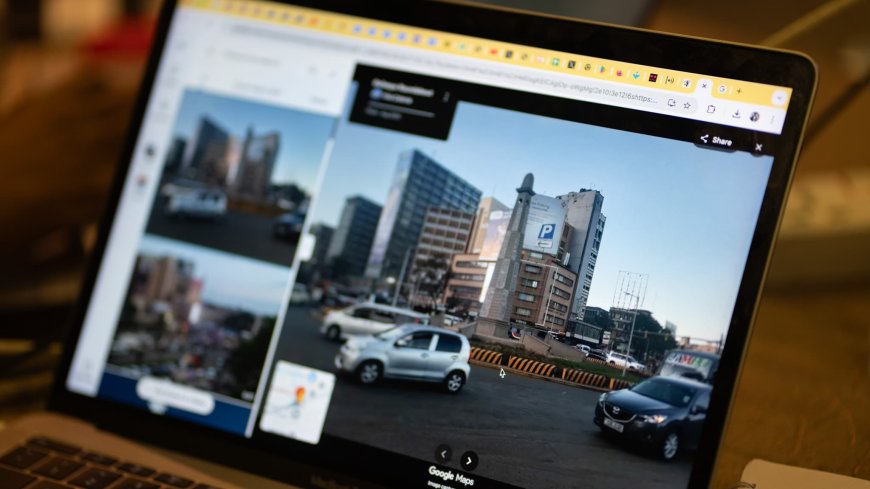 With a few clicks and careful observation, a journalist traces an online video’s location, turning pixels into proof. photo WITNESS
Trust in the media is strained; real videos are dismissed as fake, while fake ones are accepted as real.
“When trust in the media is under attack, truth must find new defenses,” said Nkem Agunwa, Senior Program Manager for Africa at WITNESS. “WITNESS stands with journalists, equipping them with new video-based strategies to fortify the truth.”
That promise loomed over the week as a guiding principle: less noise, more proof.
Much of the learning involved transforming scattered clips into a cohesive record. Journalists anchored footage to specific locations by analyzing skylines and street furniture and to specific times by observing the angle of light or the shape of a cloud bank. They cross-checked posts across platforms, maintained clean copies, logged their steps, and learned how to store originals to ensure nothing important was lost.
As the methods took hold, the language shifted from “I think” and “allegedly” to “the evidence shows.”
This work didn’t begin in Nairobi. In 2024, a pilot program in West and Central Africa brought together an initial cohort from Nigeria, Sierra Leone, Senegal, Ghana, and Cameroon. Through training, mentorship and peer exchange, they developed projects rooted in local realities.
The results were concrete: two databases documenting state and mob violence, six verification clubs at universities, and OSINT-led investigations that exposed abuses and fueled media literacy campaigns reaching an estimated five million people. What worked there guided the approach here: tools matter only if they fit the ground beneath them.
“Gathering, analyzing, verifying, and visualizing a collection of OSINT audiovisual material can reveal new patterns of violations and corroborate human rights claims from communities,” said Georgia Edwards, Program Coordinator for Evidence & Investigations at WITNESS. “It builds a powerful counternarrative to official and hegemonic discourse, strengthening the community's fight for justice.”
In the workshop, this idea wasn’t abstract. It took the form of a table full of laptops, a map gradually aligning with a frame of video, and a claim transitioning from fragile to firm.
The days concluded with the quiet work that makes truth durable: filing, naming, and storing.
“By strengthening their collecting and archiving processes, investigative journalists can better defend the truths they uncover from denial or dismissal,” said Yvonne Ng, Senior Program Manager for Archives.
Archiving wasn’t merely a backroom task; it was part of the storytelling itself, ensuring that evidence can be found, tested, and trusted long after the first story runs.
The faculty moved among the group like guides rather than lecturers: renowned OSINT journalists, creative coders, and narrative experts helping reporters shape methods that would extend beyond the week.
 A WITNESS trainer guides participants through hands-on digital verification exercises during the Fortifying Community Truth workshop in Nairobi.
Their aim was to support the cohort over the next 12 months as they translate skills into projects that safeguard truthful narratives, expand participation in accountability efforts, and push back against misinformation and disinformation.
“This project is transforming the practice of OSINT globally by starting regionally,” said Adebayo Okeowo, Associate Director of Programs at WITNESS. “It equips journalists in East Africa to lead open-source investigations in a way that centers their communities and honors their knowledge. Not only is this the right thing to do, but it is also the most effective way to build resilience against the pervasive synthetic media that undermines trust in authentic video evidence.”
Outside, Nairobi maintained its rhythm, matatus inching through traffic, vendors calling across the heat.
Inside, the cohort mapped out the year ahead: not splashy promises, but practical steps for sourcing, verifying, and preserving community evidence.
The measure of success would be both simple and challenging: whether accurate information reaches those who need it and whether, when denial arises, the record is ready.
For Seliphar and her peers, the training provided both inspiration and practical tools to confront misinformation head-on and strengthen truth-based reporting in their communities.
As the week concluded, participants reflected on what the experience meant to them:
“Thanks to WITNESS, I feel better prepared to document and verify content in challenging contexts. With the rise of AI-generated misinformation, these verification and geolocation tools are essential for journalists like us to uphold the truth,” said Olwar.
“This was a wonderful opportunity to sharpen my skills in verification and storytelling. I now feel empowered to create more human-centered documentaries and to train others in my community,” said a workshop participant.
“Thank you for enhancing my ability to verify digital content. I’m eager to share these methods with my newsroom team and my broader journalist network,” said Angela Nmpweo.
 Participants of the WITNESS Fortifying Community Truth workshop pose for a group photo. Photo WITNESS
“This was the first training of its kind for me, and it has opened my mind to how verification and archiving can protect the truth in our work. It was intense, practical, and transformative,” said a workshop participant.
“Thank you to WITNESS. I feel empowered. This training has equipped me with the tools I need to start a verification blog and support newsroom processes,” said another participant.
The project moves forward with a clear purpose: to enhance the role and influence of community-based journalism in resisting delegitimization, asserting the truth, and advancing justice.
What's Your Reaction?