




Ghosts in the Machine: AI-Driven Fisheries Erase Lake Victoria’s Women
Women fish traders at Dunga Beach power Lake Victoria’s economy but remain invisible in AI-driven fisheries data systems, risking exclusion from policy, funding and recognition.
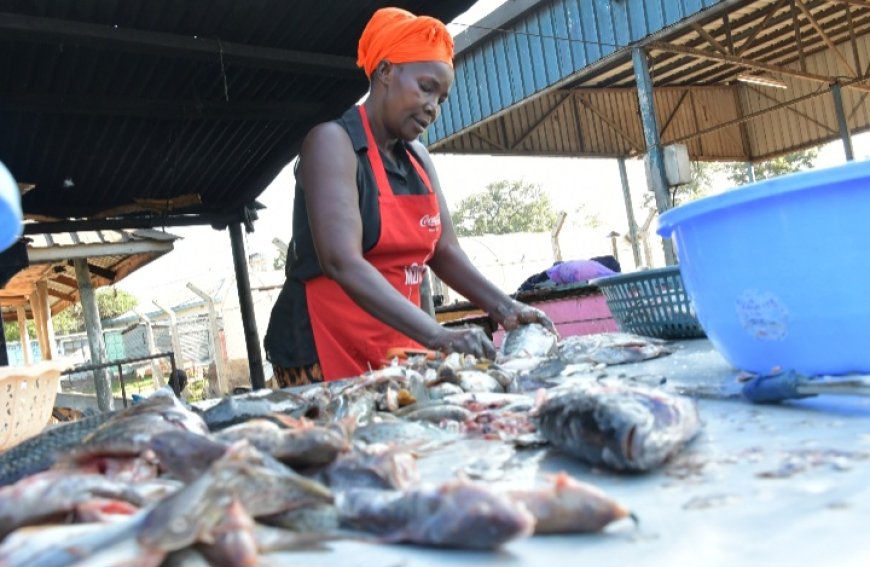
By Brenda Holo - As dawn breaks over Dunga Beach on the shores of Lake Victoria, the air is thick with the smell of fresh fish and lake water. A crowd assembles, ready to collect the catch of the day; the symphony of trade begins, and the main actors are women.
Each woman balances baskets on her head or hips as she moves towards the boats, ready to negotiate.
Among them is Grace Adhiambo, a 43-year-old mama samaki, a term used for women fish traders, who has been in this business for nearly 18 years. By 6:30 a.m., she had already secured three baskets of Nile perch, tilapia and omena.
Her hands expertly scale fish on a corrugated iron rack.
“The smallest might go for Sh300, but a good-sized tilapia will cost you Sh1,000,” she says.
Grace spends about Sh14,300 daily on stock and operating costs such as firewood and cooking oil for frying the fish. By the end of the day, she earns between Sh17,300 and Sh21,300 in sales, leaving her with a profit of Sh3,000 to Sh7,000.
"This is how I built my children's futures, fish by fish," she says. "But if you check the electronic catch assessment systems used by fisheries authorities or the Lake Victoria
Fisheries Organisation, you will not find my name anywhere. I am a ghost in their system."
Fisheries authorities use an electronic Catch Assessment Survey (eCAS), a mobile-based system that records fish species, quantities, fishing gear and vessels at landing sites.
At Dunga Beach, beach management unit officials collect data using smartphones and paper-based questionnaires, but the system does not capture traders, processors or post-harvest actors, most of whom are women.
Invisible backbone of fisheries
Across Lake Victoria, women like Grace are the backbone of the fisheries value chain. They buy, sort, scale, fry, and feed their communities.
Just behind the new Dunga market shed, Margaret Ongowe, a 50-year-old fishmonger with three decades in the trade, chases off marabou storks circling her drying omena.
"Without us, the fish would rot,” she says. "We are the ones who add value. We are the magicians who turn the catch of the night into the meal of the day."
Margaret has been a registered member of the Dunga Beach Management Unit (BMU) since 1998. The BMU is a community-level governance structure that brings together fishers, traders and processors to manage the beach and share in its benefits.
Today, members contribute registration fees and daily levies to a welfare fund managed by BMU leadership, intended to support members during emergencies such as illness or death, as well as community needs like sanitation and security.
Back then, registration was free. Now it costs Sh3,000, yet Margaret says paying does not guarantee inclusion.
“We contribute to welfare,” she says. “But when support comes, we are not considered.”
She says access to benefits and external grants often depends on formal recognition, such as business licences, boat ownership or other official records, criteria that favour male fishers over the women who dominate post-harvest work.
According to the Food and Agriculture Organization, while women make up only 24% of fishers globally, they dominate the post-harvest sector, accounting for 62%.

“When the county field officers come, they only ask for a business licence and a public health letter. They don't ask about the women who keep the whole show running," says Margaret.
Ownership without recognition
Then there is Maureen Odour.
Five years ago, she bought her own fishing boat. She employs two young men to operate it. "When I first bought the boat, people had so many questions. They said, 'Women don't fish.'” She answered, "Women don't fish, but they own the boat.”
Before becoming a boat owner, a role that still raises eyebrows, Maureen was a tilapia vendor. She saved and took a loan from a women’s group to buy her own boat, hoping to build something more stable for her family.
Even after becoming an owner, she still faces discrimination. When officials come to register boats or collect data, they instinctively turn to the two young men she employs.
“When they are collecting data, they speak to the men. They don’t ask who the owner is. They don’t see me,” she says.
With the push for digitisation, Maureen worries that women will be excluded, not because they are absent, but because systems are not designed to see them.
When fisheries go digital
Worried about the reduction in fish stocks and illegal fishing practices, authorities introduced electronic systems to record fish species caught, volume of the catches, fishing gear used, vessel registration and GPS locations at landing sites.
This data flows into national systems and regional bodies such as the Lake Victoria Fisheries Organisation. The goal is efficiency but the data represents only a narrow slice of the fish economy; it leaves out the people working after the catch, the traders, processors, and market women who move fish through the local economy.
Nicholas Didi, the chairperson of the Dunga Beach Management Unit, says members include fish traders, boat owners, and processors, 40% of whom are women.
"Before, records were on paper, and there was more flexibility. They could capture different aspects of what was happening at the landing site,” he says. “Now, the system only wants to know about the catch and the vessel," he says.
“What about the traders?" he asks. "What about the women processing the fish? That information is not captured. It is as if the story ends the moment the boat hits the shore."
Research shows that these gaps are not accidental; they are built into the design of fisheries data systems, often overlooking women’s work and limiting how decisions are made. The data feeds into national and regional databases used for fisheries management.
What is not recorded risks being left out of the system entirely, and without that information, a large part of the fisheries economy remains invisible in the data used to plan, fund and regulate the sector.
When bias enters the algorithm
Dr. Sharon Onyango, an AI and data expert specialising in agriculture, warns that this is more than a data gap.
"AI systems are trained on what exists in the data. If women are missing, the models will not account for their realities," she explains.
In practice, this means an algorithm used to allocate credit or subsidies could prioritise boat owners, who are mostly men, while excluding traders and processors like Grace and Margaret.
"Data gaps become policy gaps," Dr Sharon says. "And when AI is layered on top of biased data, it doesn't correct the bias; it simply automates it. It scales the exclusion. It makes the invisible, irretrievable."
Can the gap be closed?
David Mboya, the Deputy Director of Fisheries, Siaya County, acknowledges the limitation. Current registration systems were designed around boats and licensed fishers, but the fishing economy, he argues, is broader than that.
“It is like a river, not a puddle,” he says. “The traders, the processors, and the women’s groups are all part of the flow. We need to find a way to measure the whole river, not just one stream.”
He explains that much of the data collected feeds into national and regional systems, and local actors have limited influence over what is recorded.
Expanding the frameworks to include traders and processors would require changes at higher levels, where they are designed, something that has yet to be prioritised.
At the county level, officials say they rely on these standardised systems and have limited authority to change what data is collected, even where gaps are evident.
“We cannot plan effectively for a sector we don't fully see,” he says.
What change could look like
If the system only records fish and boats, the question is how to include the people who
handle the catch after it lands. For women like Grace and Margaret, that would mean being counted not just as part of the market but in the data used to guide decisions.
Experts, including the Food and Agriculture Organization, say digital systems do not need to be scrapped but expanded. This would mean collecting gender-disaggregated data not only about fish and boats but also about the traders who buy, process and sell the catch, recognising them as part of the formal fisheries economy.
It would also mean designing AI systems that capture how value moves after the fish leaves the boat, who handles it, who earns from it, and who depends on it.
Without these changes, digitisation will only continue to reflect part of the story, making existing inequalities harder to see and even harder to fix.
The women of Dunga Beach have sustained Lake Victoria’s fishing economy for generations, largely unseen, yet essential to its survival.
At sunrise, the boats return, and the work begins again. Fish are weighed, recorded and entered into the system. Around them, women move through the crowd, buying, sorting, drying and selling. The data captures the catch, but not the people who keep the trade alive.
This article was produced as part of the Gender+AI Reporting Fellowship, with support from the Africa Women’s Journalism Project (AWJP) in partnership with DW Akademie. The journalist used AI tools as research aids to review and summarise relevant policy and research documents and extract key statistics. All interviews, analysis, editorial decisions and final wording were done by the reporter, in line with Story Spotlight’s editorial standards.
What's Your Reaction?