









Inside Kenya’s Digital Push to Improve Maternal Health

The Sunday afternoon sun hung low over Kimangeti Village in Kakamega when the pain began, a sharp, insistent pull in Ruth Kavai’s lower abdomen.
During her first pregnancy, Ruth would have waited. She would have stayed in her house, dismissed the ache as “just part of the journey", and hoped that the sunrise would bring relief. A hospital visit meant a costly motorbike ride and a long wait for a problem she could not quite name.
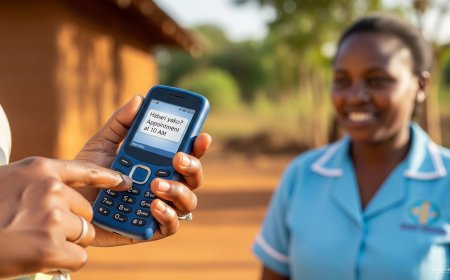
This time, things were different. Earlier in her pregnancy, a health worker had introduced her to a USSD code that enrolled her into PROMPTS, a maternal health messaging platform developed by Jacaranda Health.
All she had to do was dial, answer questions, and wait for replies. Her phone was no longer just for calling family; it had become part of how she managed pregnancy.
PROMPTS sends guidance on pregnancy and newborn care via SMS and allows mothers to ask questions, linking routine automated messages with a clinical helpdesk when concerns arise.
During enrolment, mothers dial a short code, select their language and facility, and begin receiving messages tailored to their stage of pregnancy or motherhood.
“The AI reads and evaluates the urgency of the messages mothers send. If it flags something high-risk, like heavy bleeding, it escalates to qualified nurses and medics, who respond within an hour,” explains Benjamin Mulyungi, Jacaranda Head of Technology.
“With my first child, I never received messages like these. You would face problems but wouldn’t know what to do about them. You would just say, ‘This is a normal thing,’” says Ruth.
 Ruth Kavai from Kimangeti during an interview at Malava Hospital in Kakamega County.
“It was helping my health as a pregnant woman. I also asked them questions. I would ask, ‘I have a companion who hasn’t been introduced to this; how can they be tested?” Ruth explains.
The messages reminded her when to take medicine and when to return to the clinic. They even advised her to walk long distances so the baby would be positioned well, something she had never been told during her first pregnancy.
Most importantly, they had prepared her for that Sunday afternoon.
“I remembered a message that had been sent before. Based on the pain I was experiencing, I decided to go to the health centre and see how I would be handled,' Ruth recalls.
On Monday morning, she was at the clinic at the Malava Hospital. By Tuesday, she had been admitted to the ward, something that might never have happened during her first pregnancy, when she would have waited at home for the pain to pass.
This early visit may have prevented complications in a country where the maternal mortality ratio is 355 deaths per 100,000 live births, and the neonatal mortality rate stands at 21 deaths per 1,000 live births, according to the most recent Kenya Demographic and Health Survey.
Yet even as the system guided her care, the realities of rural living created new obstacles. In the quiet of the ward, Ruth’s phone credit ran out. A message arrived, but she could not read it until morning.
“A message might be sent at night when I haven’t paid. I received it in the morning. If I reply then, I won’t get a response anymore. It will have expired,” she says.
There were also moments when the system felt strangely distant. One night, it sent her a message asking if her baby was breastfeeding well, even though she was still pregnant. The error stirred a real fear.
“I’m afraid to tell them I haven’t given birth, because maybe if I do, they won’t send me messages anymore. We won’t continue communicating,” she admits.
For Ruth, the technology is a lifeline, but one that needs a human touch. She wishes she could text first when she notices something wrong, instead of waiting for a prompt.
She wants health workers to have her number ready and to understand that sometimes the only thing standing between a mother and the hospital is the cost of transport.
Not a panacea for systemic gaps
While digital health tools like PROMPTS are reshaping maternal healthcare, they do not address the systemic issues underlying high maternal mortality. Many deaths occur in the gap between when danger signs appear and when help arrives.
Across Kenya, research links maternal and newborn complications to what health experts call the “three delays”: delays in seeking care, reaching health facilities, and receiving timely treatment. In rural areas, these delays are often driven by transport costs, distance, misinformation, and persistent health system gaps.
These challenges cannot be addressed by technology alone, and technology itself is not without challenges. Digital health systems developer Bonface Otieno offers a reality check on the risks, sustainability, and ethical considerations of AI in maternal health.
“AI has enormous potential to improve maternal health outcomes, but it comes with risks,” Bonface explains. “We need health systems ready to maintain them, trained local staff who understand the technology, and alignment with national policies and maternal health guidelines. Otherwise, projects risk collapsing after pilot phases.”
Bonface also stresses inclusivity: “Women from diverse backgrounds, across geography, disability, and socioeconomic status, must be represented in datasets and the design of AI tools.
Messages need to respect cultural norms and languages, and AI must support frontline health workers, not just hospitals. Ethical governance and participation from women and communities are essential.”
Digital presence in maternal care
At one of the hospitals using the AI-enabled SMS platform, Janet Wanyama, a nurse, says that the automated messaging system has become a constant presence in maternal care.
Before they adopted the programme, the hospital’s reach ended at its gates. Health information was shared through barazas and morning talks, but many women from distant villages missed these sessions.
“Previously, we could only give health messages in the morning,” Janet explains. “With the high workload, a mother would often leave without individual advice. But with this programme, she can read on her phone and get information at any time.”
“Sometimes we are overwhelmed and might forget to mention something,” Janet admits. “But a mother who has read the information will know her next visit includes a certain test. She will even say, ‘Nurse, you haven’t done this for me yet.’”
“Before, a woman might have stayed home with blurred vision, severe headaches, or reduced fetal movement, thinking it was normal. Now, she comes to the hospital,” she adds.
She recalls a woman at 34 weeks who noticed she was leaking fluid. Because of an SMS, she did not wait for her next appointment; she rushed to the hospital.
“If she had stayed at home, we could have lost that pregnancy,” Janet says.
In another case, a mother brought in her two-week-old baby who had suddenly stopped breastfeeding.
“That is a danger sign. The baby had been feeding well, then suddenly refused and became irritable,” Janet says.
Because the mother had been trained by SMS to watch for such changes, she did not wait. The baby was admitted immediately. Doctors confirmed neonatal tetanus.
“The speed of her response saved that child,” Janet says.
Janet says the messages are also changing how some families prepare for birth, with old customs, like waiting until a baby is born before buying clothes for fear of bad luck, fading.
“Mothers now buy baby clothes in advance because they know the baby must be kept warm immediately,” Janet says. “Women save ‘pocket money’ from their husbands for delivery."
Real-time data shapes experience
Inside the hospital, a digital dashboard shows the mothers’ experiences in real time. They are no longer silent faces in long queues but active participants shaping how care is delivered. When someone reports long waiting times or missing supplements, the system flags it.
“It helps us see if the hospital has run out of supplies like iron tablets,” Janet explains. “If a staff member didn’t handle a mother with dignity, we address it.”
When Beatrice Amakove experienced bleeding, she wasn’t sure whether it was serious. She reported it to PROMPTS, and within minutes, the clinical helpdesk reached out. She was referred to a health facility, where she discovered she was in labour.
“Antepartum haemorrhage (APH) is an obstetric emergency. The dashboard helps us see if we need more training, more blood, or better preparedness,” Janet explains.
The dashboard maps individual messages into patterns visible to the hospital, the developer, and county officials.
“Mothers tell us when a clinic has no water. They praise nurses who treat them with respect. If hypertension is high in one area, the county sees it in real time and asks, 'Is it a lack of medicine or a lack of information?'” says Janet Achieng, a programme officer with Jacaranda Health, the organisation behind the platform, which runs in 24 counties in Kenya and three other countries, Tanzania, Ghana, and Eswatini, with more than 4.2 million mothers enrolled.
Yet even as she welcomes the gains, Janet sees where the digital bridge cracks. In rural Kakamega, a phone is still a luxury, making it difficult to reach teenagers who borrow phones to read a message and women who change numbers frequently.
“Sometimes mothers don’t have phones. Or they give their husband’s number, but he is working far away,” Janet says.
To close the gap, women without phones are registered under a community health promoter's number.
Guidance for younger mothers
For younger mothers like Miriam Nanzala, who became pregnant at 19 while in Form Four, the messages have helped shatter myths. A nurse registered her on PROMPTS at seven months, replacing rumours with regular guidance on her phone.
“People told me the medicine from the hospital would harm the baby,” she says.
“The messages said the medicine would not cause disability. It was protecting my baby,” she recalls.
When she went into labour at eight months, she was frightened but not unprepared. After delivery, the messages shifted to her newborn’s care.
“The messages told me how to dress my baby. They even taught me how to test his development using a bottle with beans to see if he could follow the sound,” she says.
Nine months into motherhood, she sees the difference between herself and friends who are not on the system.
“When their babies get a fever after vaccines, they panic. I didn’t, because I knew it was normal,” she says.
“When my baby reached six weeks, they taught me about family planning. Without that, I might already be pregnant again.”
Insights from data
Beverly Wambani, Kakamega County’s Coordinator for Reproductive and Maternal Health, says the county initially adopted PROMPTS to improve the quality of care, first piloting it in five sub-counties, Malava, Lumakanda, Likuyani, Butere, and Matungu, then expanding it countywide. In the pilot phase in Malava, 213 high-risk pregnancies were identified early and referred.
“When a client visits a facility, the system asks them to rate the service they received. If they were supposed to get an ultrasound, it asks whether it was done. That gives us immediate insight. If there is a gap, we act on it,” she says of the system that has been running for three years.
“Our goal is that every mother in Kakamega is registered, so no woman navigates pregnancy alone,” Wambani says.
County data, recently reported by County Public Health Chief Officer Rose Muhando, suggest early improvements. Neonatal deaths have fallen from 26 to 20 per 1,000 live births, while institutional deliveries have risen from 47 per cent to 89.5 per cent, though officials note multiple interventions contributed to the gains.
Programme data from Jacaranda Health also indicate shifts in care-seeking behaviour among 4,000 mothers enrolled in Kakamega every month, including high vaccination completion (97 per cent) and strong exclusive breastfeeding rates (89 per cent).
Need for oversight
Some experts warn that digital expansion without strong oversight could introduce new risks. Digital health systems developer Boniface Otieno notes that while AI holds significant potential for maternal care, safeguards are essential.
“Data bias can lead to inaccurate predictions for women in low-income or rural settings, and because maternal health data is highly sensitive, strong privacy and accountability measures are essential,” he says.
Kenya’s Data Protection Regulations govern how personal data is collected, processed and shared and classify health information as sensitive data requiring explicit consent and additional safeguards.
The rules require data controllers to inform users, in this case, mothers enrolling in systems like PROMPTS, how their data will be used, including any automated decision-making and sharing with third parties.
Jacaranda Health says PROMPTS collects only the minimum information needed to operate the service and that the data is encrypted and anonymised.
The organisation says this allows messages to be timed to each mother’s stage of pregnancy or early motherhood and that the data is shared with government partners through PULSE dashboards for planning purposes.

"We are compliant with the Data Privacy Policy in Kenya. All mothers consent upon registration. We do not take the names of mothers, ages and other biodata. We only take a phone number, gestation dates, and the facility they visit. This data is stored and used only as per the guidelines," says Benjamin Mulyungi, Head of Technology at Jacaranda Health.
Limits of digital tools
While digital tools are expanding access to information for pregnant women, quality-of-care gaps remain uneven across facilities. These gaps cannot be solved by technology alone. Without broader health system improvements, Kenya may struggle to reach its target of fewer than 70 maternal deaths per 100,000 live births.
As Ruth recovers in the ward, her midwife, Janet, is already thinking about what happens when the messages stop. Right now, the digital connection ends when a baby turns one, and to her, that silence is risky.
“Between age one and two, there are measles vaccines, vitamin A, and the malaria vaccine. This is also when malnutrition and infections begin. I would prefer the system continue for at least three, even five, years,” she says.
Ruth worries about that too, but she says the system, though imperfect, helped guide her care. This time, she did not have to navigate pregnancy and the postnatal period alone.
This article was produced as part of the Gender+AI Reporting Fellowship, with support from the Africa Women’s Journalism Project (AWJP) in partnership with DW Akademie. The journalist used AI tools only as research aids to review and summarise relevant policy and research documents and extract key statistics. All interviews, analysis, editorial decisions, and final wording were done by the reporter, in line with Story Spotlight’s editorial standards.
What's Your Reaction?