




When a Victim Is a Man
After a domestic attack, one survivor’s story exposes the silent crisis of men facing violence in Kenya and the stigma that keeps them unheard.
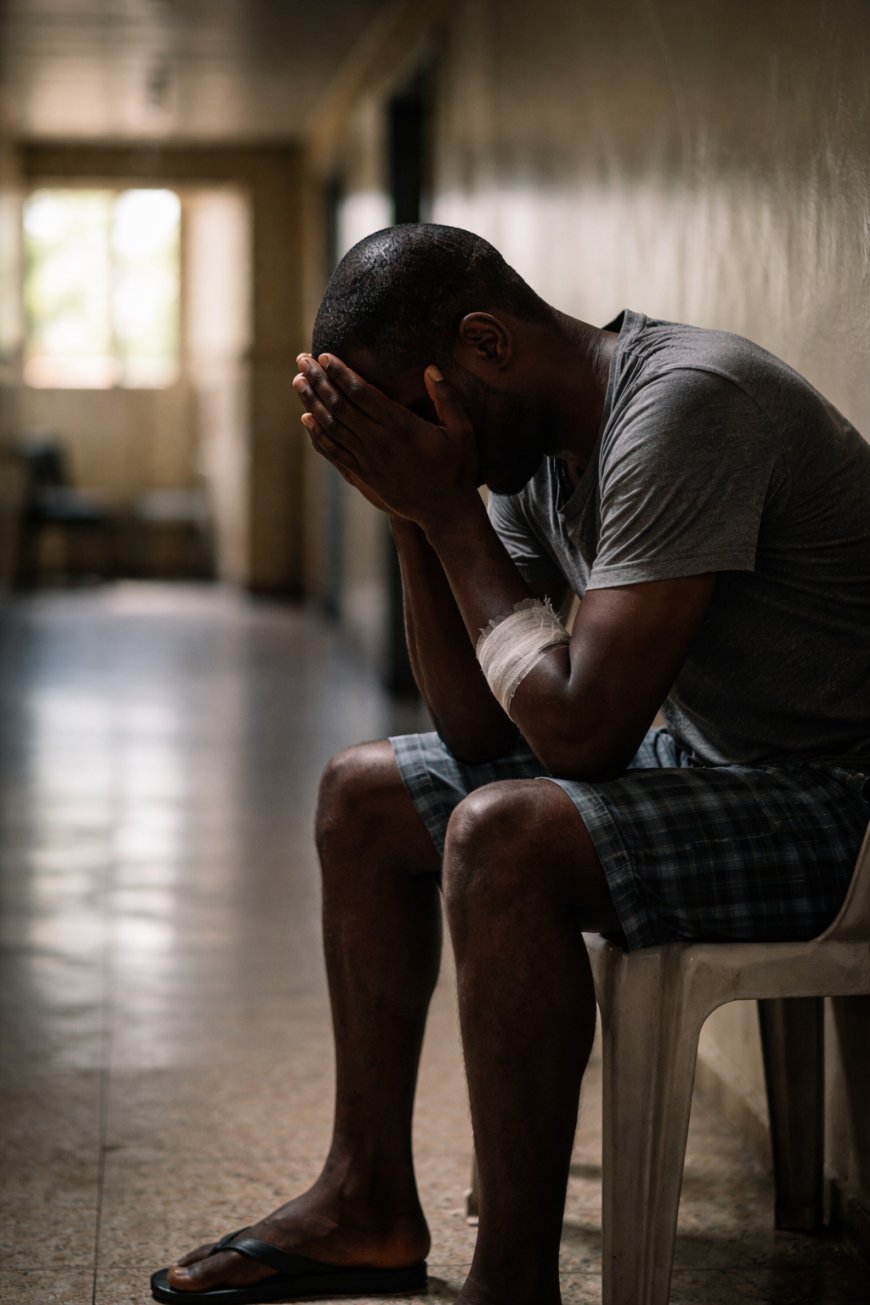
Ishmael Oundo says he no longer sleeps the way he used to.
Even when he finally closes his eyes, he wakes suddenly, startled by the smallest sounds, his body reacting before his mind does. Sleep, which once helped him rest after long day of hustling, now reminds him of the night his life changed.
Sitting on a blue plastic chair outside Brimaxa Hospital, shirtless and quiet, Oundo avoids eye contact as he speaks. Scars cover parts of his face, chest, and arm, injuries he says he sustained after being burned with hot water while asleep in his house on January 14, 2026. He alleges that the attack was carried out by his wife, Marceline Auma Wanjala, popularly known as Adoyo Actress.
“I was deep asleep,” he says quietly after a long pause. “Very deep. I didn’t even hear her come near me. I just found myself outside screaming for help in the middle of the night. I begged my neighbours desperately.”
According to Oundo, his wife poured boiling water on him as he slept, turning what should have been a night of rest into a moment that would permanently alter his life. What makes the incident even more haunting is the date: it happened on his daughter’s third birthday, a day they share.
“A day that was supposed to be full of joy,” he says, shaking his head slowly. “Instead, it became the day I almost died. It was my birthday and my daughter’s too, so we threw a small party. Children were there, we cooked chicken, cut cake, then I left the house briefly to watch football at a joint in town.”
“We woke up in high spirits, and since it was my child’s birthday, I even instructed her mother not to take her to school so that we could celebrate together. I didn’t go to work that day. I wanted family time, not knowing my life was about to take a different turn.”
A Domestic Argument That Turned Deadly
Oundo says the attack did not follow a violent confrontation or dramatic fight that night. There were no screams, no neighbours banging on doors, no threats exchanged moments before. There had been an argument earlier, yes, but nothing, he insists, that prepared him for what followed.
“Like any couple, we disagreed that day about messages she found on my phone,” he recalls. “She asked for my phone and insisted I give it to her. She saw that a colleague had wished me a happy birthday. She became angry, but I tried to explain that the woman was my schoolmate from high school.”
“We argued until around midnight. Words were said. I thought things would cool down, so I decided to go to bed to avoid further drama, especially since I was supposed to go to work the next day. I believed her anger would fade.”
He says that assumption nearly cost him his life. He remembers the pain that woke him before he could even scream.
“It felt like fire was sitting on my skin,” he says, lifting his injured arm slightly. “I jumped up, but my body was already burning. I was confused. I didn’t understand what was happening. Then I remembered my child. I ran back into the house to make sure they were safe. They weren’t there. I even looked under the bed. That’s when I realized she was the one who had poured the hot water on me.”
“I knocked on my neighbour’s door, screaming for help. One woman came out, and I borrowed cold water. When I poured it on my body, she realized my skin was peeling off. She told me I had serious burns and needed to rush to the hospital. I was alone; my phone was off.
I walked 500 metres to the road, shouting for help. It was terrible. Luckily, a night boda-boda rider passing by rescued me and took me to Brimaxa Hospital. I looked so angry that even the nurses were scared. I didn’t even have money to pay the person who carried me,” he adds.
Ishmael’s injuries reflect a disturbing trend in Kenya. National Crime Research Centre data shows that men are disproportionately victims of “chemical and liquid” attacks.
While only 1.2% of female GBV victims report burns, nearly 14.3% of male victims suffer scalding or burn-related injuries in domestic settings. Furthermore, recent data highlights that male victimization is often defined by psychological harm, with 74% of men in abusive relationships reporting controlling behavior.
 National data reveals a specific pattern in domestic settings where men are significantly more likely than women to be victims of scalding or burn-related attacks.
Oundo, the firstborn of six, says that by the time he received help, large portions of his upper body were badly scalded.
“I borrowed a phone to call my parents, but because of how I looked, no one would give me theirs. It was a long night. I regret spending the night at that house. How I wish I had left. How will I live with this scar? How will I work from here?”
The following day, he called his uncle, Afton Opanga, and his friend, Daniel Kirevi, after finally getting access to a phone.
“I am improving physically, but emotionally it’s tough. I didn’t know it then, but that day would redefine my life. Accepting scars, you never had before, scars you never imagined having, is not easy. How will I tell my child in the future about them? Life can change so fast. I never imagined I would one day be counted among men abused in their own homes,” he says quietly.
Yet beyond the physical wounds, Oundo says the hardest part has been something far less visible: being believed.
When Men Are the Victims
“Male victims of domestic violence rarely make headlines in Kenya unless their cases end in death. Even then, their stories are often reduced to footnotes. In my case, she went to report first. She was given cash bail, she is free, and she even mocks me on social media. If I had done what she did, the world would be on my neck. But now, since I am the victim, this is how it’s being handled,” he says, shaking his head.
He says the difficulty is rooted in a deeply ingrained assumption that men cannot be victims, only perpetrators. Oundo recounts that his wife initially reported him to the Busia police station, claiming he had assaulted her. His family went to report their version, saying she was lying. She was arrested but later released on cash bail.
“You see, she walks freely while I suffer in hospital. She even had the courage to report that I assaulted her when I was the victim. When I tell people what happened, some laugh. Others say I am faking it. I will never marry. Today, an ordinary day feels like hell. I am the breadwinner for my family, how will my parents eat? My mother is sickly,” he says, his voice trailing off.
“No one asks what pain a man carries,” Oundo adds. “I saw death that day, and I will never forget it. Right now, my hospital bill is around Sh80,000, and I am appealing to well-wishers and the government to help me. We cannot afford to pay it.”
In hospitals, police stations, and even among friends, he says he has encountered scepticism and silence rather than sympathy. Reporting the incident felt like standing alone in a crowded room.
“As a man, you are expected to be strong. If you say your wife hurt you, people look at you like you are weak or lying.”
Oundo’s ordeal is not an isolated case. Dan Muhandale still remembers what happened to him in 2022. He says his wife and her sister-in-law attacked him while he was watching television at their home.
“They beat me like a child. I was helpless because I am blind, I couldn’t defend myself. They left me with permanent marks. She even bit my lips. We were alone because the children had gone out,” he recalls.
The father of two says he tried to seek justice, but police allegedly sided with his wife, even threatening him with arrest.
“I never got justice up to today. The case just disappeared. The only thing they did was transfer the OCS. I still have all the statements. Criminal cases don’t end, one day I will fight for my justice,” he says.
The incident also deeply affected his children.
“They were nine and six years old. They are still bitter up to today. I talk to them every day, trying to help them heal. Anyone who has been harassed can relate. It’s high time the government acted so that men can also see justice served.”
He believes cases involving male victims are often watered down or dismissed altogether.
However, when contacted, Marceline Auma Wanjala said the matter was in court and that she had been advised by her lawyer not to speak for her own safety.
“My lawyer instructed me not to talk about the matter. Once I am given a go-ahead, I will tell my side of the story. I appreciate being contacted, but for now, I cannot speak. I was also instructed not to reach out to the complainant or his family,” she said.
The Barriers Male Victims Face
Experts say stigma is one of the biggest barriers preventing male victims from seeking help.
Advocate for male survivors of GBV, Onyango Otieno, says men face unique challenges because society struggles to accept them as victims.
“If it were a woman who had been burned, the country would be on fire. But when it’s a man, there is silence,” he says. “Men need to speak up for other men who are abused. Where are the men? Why are they silent?”
He clarifies that recognising male victims does not erase women’s suffering.
“I am not saying women do not suffer, they do, very much. But we have created a world where only one side is allowed to cry.” Onyango adds that society often assumes men cannot be victims because of long-held beliefs that violence only flows in one direction, from men to women.
“Our brains don’t react as quickly when it’s a man,” he explains. “We need more advocacy and public awareness to let people know that men can be victims too. In Oundo’s case, where are the older men or his peers? We need their voices. Men need to speak up for fellow men.”
He says another challenge lies at police stations. Most GBV reporting desks are run by women, which can make men uncomfortable when seeking help.
“When a man goes to report, the first stigma he faces is ridicule,” Onyango says. “Who manages the gender desk? It’s mostly women. Men also need representation, and police officers must be trained to understand that men, too, experience abuse.”
Onyango adds that the media also plays a crucial role in shaping perceptions about male victims.
Psychologist Hendricks Ademba explains the psychological toll men endure after GBV.
“Men often feel shame and powerlessness. Pride is tied to their ability to provide and protect. When violence happens, they question their role and worry about what the community thinks,” he says.
He adds that physical scars are only part of the trauma.
“Oundo’s self-image may change; he may feel estranged from his own body. He has a one-in-ten chance of developing post-traumatic stress disorder, which can evolve from acute stress disorder diagnosed within days of trauma.”
Symptoms can include intrusive memories, nightmares, hyperarousal, anxiety, irritability, sleep problems, and avoidance of reminders. Men often express distress through physical complaints such as headaches or digestive issues, while anger may be more pronounced than sadness.
Ademba warns that the effects of abuse can ripple across generations.
“Children learn templates of relationships from parental interactions. Exposure to GBV can shape their understanding of relationships later in life,” he says.
He also points to a wider societal consequence.
“Some men who experience GBV develop resentment or misogyny. Online communities can amplify this, and the pent-up aggression may manifest as violence or even murder.”
To restore a sense of agency, Ademba recommends vocational and industrial activities alongside counselling.
“Shame involves powerlessness; guilt involves regret for past inaction. Statements reflecting guilt are a positive step. Men need opportunities to accomplish tangible goals, alongside therapy and spiritual guidance, to fully heal.”
Advocate William Anyonje highlights legal and reporting gaps.
“The Protection Against Domestic Violence Act (2015) defines domestic violence and prohibits various forms, but in practice, men are largely left unprotected. Only about 5 percent of male victims report incidents, while 90 percent remain silent, often due to psychological trauma,” he says.
He adds that humanitarian organizations and legal frameworks focus overwhelmingly on women.
“In my career, I’ve never seen a man report rape. Men must advocate for themselves and challenge toxic masculinity. Abuse should never be normalized for anyone.”
Anyonje calls for legal reforms to ensure balance and confidentiality.
“The law exists, but implementation is the problem. Sexual offence laws must not favor women exclusively. Men’s centres and private courts could protect dignity and reduce psychological harm.”
Statistics Reveal a Deeply Hidden Crisis
National data reveals a stark gender disparity in the experience of violence, though the numbers for men suggest a crisis that is often masked by silence.
According to the 2022 Kenya Demographic and Health Survey (KDHS), 34 percent of women in Kenya have experienced physical violence since age 15, compared to 10 percent of men.
While women aged 45–49 report the highest prevalence at 42 percent, the data for men remains significant, with 7 percent reporting physical violence within the last 12 months alone.
The nature of violence within the home also shows distinct patterns. Among married or cohabiting couples, roughly 37 percent of women and 23 percent of men have experienced some form of Intimate Partner Violence (IPV).
 Beyond physical injuries, the vast majority of male survivors report experiencing high levels of controlling behavior and emotional abuse within their relationships.
For women, these threats often begin early; sexual violence during pregnancy affects approximately 6.3 percent of women, and the national prevalence of Female Genital Mutilation (FGM) stands at 15 percent, rising to 23.5 percent among those aged 40–49.
However, recent data from Amnesty Kenya (2025) and secondary analyses of the KDHS highlight that male victimization is defined by high levels of psychological and controlling harm.
Among men with intimate partners, 36 percent report experiencing "any form of violence," with a staggering 74 percent reporting controlling behaviour or emotional abuse. Physical IPV affects 7.5 percent of men, while sexual IPV is reported by 5 percent.
These figures likely represent only a fraction of the reality. While 7 percent of men and boys report lifetime sexual abuse, Amnesty Kenya notes that social stigma prevents many from coming forward. Localized studies in high-density areas, such as the Kisumu slums, show prevalence rates for male IPV as high as 76 percent.
The path to justice remains the steepest barrier for male survivors. Recent legal data indicates that only 3 percent of male-reported sexual violence cases proceed to formal investigations, compared to 12 percent for women.
For decades, national conversations on GBV have rightly prioritized women and girls because they face the highest risk of lethal violence. However, as experts and human rights organizations now warn, a gender-neutral approach to protection is essential to ensure that no victim is left in the shadows.
What's Your Reaction?